Where ceiling water damage comes from in Flagstaff
Ceiling leaks have more possible sources than any other kind of water damage, and fixing the stain without finding the source just means painting twice. These are the usual suspects in a Flagstaff home, roughly in order of how often they show up:
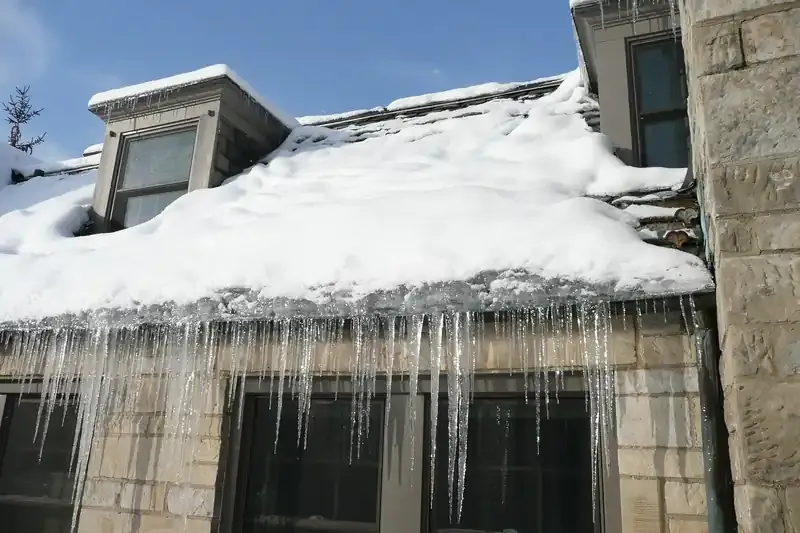
- Ice dams. Heat escaping from the living space melts snow on the upper roof. The meltwater runs down to the cold eaves, refreezes and builds a ridge of ice. More meltwater backs up behind it and seeps under shingles into the attic and down the top of the exterior walls.
- Snowmelt and wind-driven snow. Heavy wet snow sitting on a roof for weeks finds every weak flashing and nail hole. Wind can also drive powder snow through roof and soffit vents into the attic, where it melts.
- Plumbing above. A wax ring under an upstairs toilet, a shower pan, a drain line or a frozen supply line in an attic or exterior wall.
- Monsoon storms. Hard summer rain with wind tests flashing around chimneys, skylights and swamp-cooler or HVAC curbs on the roof.
- Condensation. Bathroom fans vented into the attic instead of outside, or poorly sealed attic hatches, can wet insulation and stain ceilings in winter with no leak at all.
Ice dams: the classic Flagstaff ceiling leak
If the stain sits near an exterior wall, appeared during a stretch of snow followed by sunny days, and you can see thick ice and icicles along the gutter line, an ice dam is the prime suspect. Flagstaff gets plenty of snow, and its sunny winter days create exactly the melt-and-freeze cycle that builds dams.
Getting the ice off the roof edge stops the active leak, but chopping at it with an axe or hammer damages shingles. Roof rakes from the ground can pull snow off the lower few feet of roof. Steamers used by roofing contractors melt channels without damaging the roof. The long-term fix is in the attic: more insulation, air sealing around lights and hatches, and good soffit-to-ridge ventilation so the roof deck stays cold. The guide on ice dam ceiling leaks goes into the details.
How a wet ceiling gets dried and repaired
- Find and stop the source. Roof, plumbing or condensation. Until it is stopped, nothing else sticks.
- Check the attic. Wet blown-in insulation compresses and holds water against the drywall. It is usually removed from the wet area and replaced after drying.
- Relieve and remove. A sagging ceiling is drained and the soaked drywall is cut out. Drywall that is only stained but still firm can often stay.
- Dry the cavity. Air movers and dehumidifiers dry joists, top plates and any wall cavities the water ran into. Readings confirm it, just like any water mitigation job.
- Repair. New drywall, matching texture, a coat of stain-blocking primer, then paint. See water damage repair for matching details.
If the stain smells musty, has dark speckles or keeps spreading after the leak stopped, there may be mold on the back of the drywall or on the attic sheathing. That moves the job into mold remediation.
Is a sagging ceiling an emergency?
Yes. Drywall soaked with water gets heavy and soft, and a bulging section can come down suddenly with gallons of water behind it. Keep people and pets out of the room, move what you can, and do not push on the bulge. If you can stand well to the side, a small hole punched at the lowest point with a screwdriver lets the water drain into a bucket in a controlled way. Then call for help. Ceiling light fixtures in a wet ceiling should be shut off at the breaker.
Ceiling water damage costs
A small stain that dries quickly may only need stain-blocking primer and paint, often $500 to $1,000 including drying checks. Replacing a ceiling section with matched texture commonly runs $900 to $2,200. Wet attic insulation adds roughly $800 to $2,500 depending on the area. A collapsed ceiling in one room, with cleanup, drying and rebuild, more often lands between $1,800 and $3,500. Roof repair or ice dam removal is a separate bill from a roofer.
| Source | Usually covered? |
|---|---|
| Sudden roof damage from wind or a falling limb | Often covered, minus deductible |
| Ice dam leak | Interior damage often covered; many policies exclude the roof repair itself |
| Burst pipe in attic or wall | Usually covered if sudden |
| Long-term roof wear or slow leak | Usually excluded |
Ceiling stains in older and newer Flagstaff homes
Older homes around downtown often have low-slope additions, older flashing and plaster ceilings that hold water longer before showing it. Newer subdivisions on the south and west side have more complex rooflines with valleys and dormers, which is where ice and snow pile up. Manufactured homes, common in parts of the east side and outlying areas, have thin ceiling panels that stain and sag quickly. In every case, the brown ring shows up after the damage is done, so act on the first one.
Ceiling leaks in condos and townhomes
In a condo or townhome, the leak in your ceiling may start in your neighbor's unit or in a common roof. That changes who pays. Typically the HOA's master policy covers the roof and common elements, while your own HO-6 policy covers your interior finishes. Notify the HOA or property manager right away, take photos, and ask your neighbor to check their bathroom or kitchen if the stain is under their unit. Drying should not wait while the question of responsibility gets sorted out.